Blindness
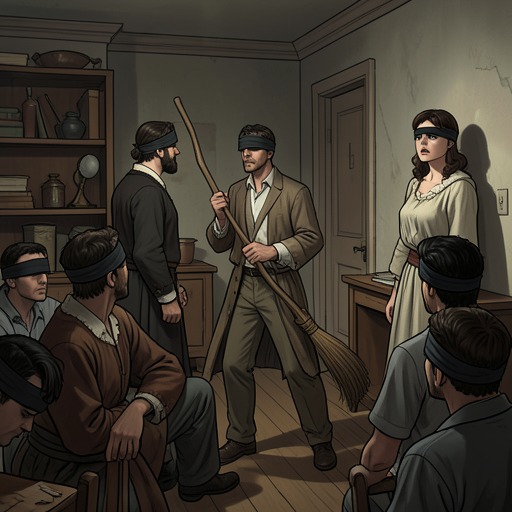
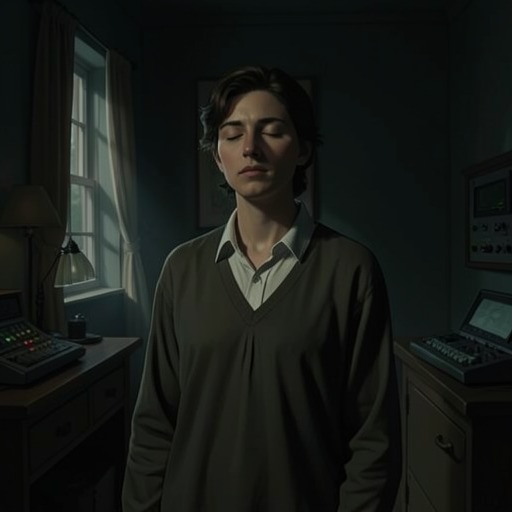
Bird BoxBlindness in the novel is at once a defense against the creatures and a condition imposed on everyday life. Because direct sight can bring on madness, survivors cover their eyes and learn to navigate by sound, touch, and remembered paths. At Tucker, Rick’s account gives the practice a history: self-blinding became the community’s absolute protection after a security failure, then receded when the school was fortified. The contrast makes blindness both an urgent survival measure and a burden that people may be able to set down when their circumstances change.
Survival Rules and Daily Practice
The danger of sight produces strict rules well before the practice is explained at Tucker. Malorie tells the children that neither may remove a blindfold under any circumstances, and warns that disobedience will bring punishment. For her, protection depends not only on wearing a blindfold herself but on making the rule reliable for two children who must navigate a world they have never seen.
That rule is reinforced through training from infancy. Malorie waits beside the children’s chicken-wire beds with a flyswatter; when either child opens their eyes, she strikes an arm, closes the child’s eyes, and withholds feeding until the safer behavior is repeated. The method joins an essential survival lesson to fear and reward. The children learn to wake with their eyes closed, but the discipline also excludes the ordinary freedoms Malorie remembers from her own childhood, when she secretly broke household rules for sugar, television, or the chance to sleep in the living room.
As toddlers, the children practice locating Malorie by sound and movement rather than sight. She walks around the living room, leaves and returns, and asks where she is or where she had been; they point, and she corrects them when they are wrong. They soon become consistently accurate. The exercise turns the home into a training ground, where orientation and attention to another person’s position can be rehearsed without looking.
At three, they are taught to fetch water from the well. Malorie ties herself to the Boy with a rope and sends him along the path, instructing him to feel for it with his toes. She listens as he raises the bucket and carries it back; when it falls, she makes him try again. The Girl objects that the ground is too uneven and feels as though people live beneath the grass, but Malorie withholds food until she agrees to do the task. The well thus becomes more than a source of water: it is a test of whether the children can perform necessary work while blindfolded, and of the coercive discipline Malorie considers necessary to prepare them.
The household’s routines make the cost of blind living visible in practical details. Felix approaches the well with one of the six buckets, a heavy wooden one with a black iron handle, while a rope tied to his waist is anchored to a steel stake outside the back door. He follows a path outlined by pieces of old picture frames, using them to keep from straying to either side. The makeshift route and tether do not remove risk; they give the blindfolded household a material system for managing it. Felix even says the weight of the bucket keeps him grounded.
Blindness also governs movement through the house during emergencies. When Felix is brought inside after an incident at the well, people speak over one another until Tom tells everyone to close their eyes. The instruction immediately changes the group’s response: amid confusion and shouting, blindness is treated as a precaution that must be restored before anyone can make sense of what has happened.
Community, Resources, and Organization
In the early settlement, survival under blindfolds depends on collective stores and shared labor. Felix says that the housemates made a supply run just before the first reported incident in the Upper Peninsula and had enough canned goods to last about three months. Don points out that the supply will run down sooner with another person in the house. The blindfolded household is therefore not sustained by a rule alone: food stocks, water, and the labor of its members determine how long its closed and guarded way of life can continue.
The rules also leave room for practical leadership. When the housemates are caught in growing panic, Malorie assigns work rather than allowing the day to dissolve into fear. She proposes preparing dinner, emptying the waste bucket, improving the cellar, checking the yard for tools, feeding the birds, making telephone calls, and washing bedding. She connects clean sheets to the small comforts that make life in the house bearable. The moment shows blindness as a condition the community must organize around: ordinary chores continue, but each requires thought about safety, resources, and who can do what.
At Tucker, blindness has become a collective policy with a specific historical cause. Rick tells Malorie that the community’s first period there was marked by hunger and the absence of later amenities. People went out to hunt without the security they would eventually build. During one such outing, a creature entered the settlement, and many people were lost. In the aftermath, a mother who had been rational killed four children. Rick presents the tragedy as the reason the community vowed not to expose itself to that risk again.
The Old Way at Tucker
The survivors’ response was to blind themselves with whatever they could use, including forks, kitchen knives, and their fingers. Rick describes blindness as absolute protection under the conditions they faced then. The practice did not arise as an abstract doctrine or a permanent mark of belonging; in his account, it followed a specific breach of security, mass loss, and the community’s decision to prevent another comparable disaster.
Malorie encounters the consequences of that decision in the school’s hallway. A group of young women passes with walking sticks, moving by touch and sound; their eyes have been replaced by large scars. Malorie pulls the children close, and they hide their faces against her legs. The sight makes the policy’s bodily permanence immediate, while the women’s shared movement also identifies them as members of a community that has built a life around blindness rather than treating it as an isolated individual condition.
Rick explains that Constance can see, distinguishing her from the many people who are blind. His account then marks a change in the community’s approach: after a year, the settlers had fortified Tucker enough to ease the burden, and they had experienced no further security lapses. The school no longer requires everyone to blind themselves. In this new arrangement, safety rests on the community’s defenses rather than on the irreversible sacrifice of every person’s sight.
Release, Memory, and Significance
The transition away from the old policy is presented through an invitation and Malorie’s refusal to let the children go first. Constance tells her that it is all right to open her eyes, but Malorie grips the Boy and Girl and insists on testing the step herself. After years of training them to keep their eyes shut, she approaches the possibility of sight as a risk she must take on their behalf.
When Malorie opens her eyes, she finds a brightly lit school with a long hallway, clean floors, high ceilings, bulletin boards, and no windows. The physical environment is orderly and provisioned: Rick and Constance describe fields of potatoes and squash, summer berries, and a method for purifying rainwater. Handwritten notices record recovery and daily assignments for farming, water purification, and medical evaluations. These details help explain why the community can reconsider the old practice: its security, food production, and water supply are now organized differently from the precarious settlement Rick remembers.
Rick himself is blind, his unfocused eyes and worn walking stick making clear that the former policy has enduring consequences for those who followed it. Constance, by contrast, can see. Their presence together prevents the new order from being reduced to a simple reversal: the community has changed its rules, but the people living under the old ones still bear them. Malorie also remembers George’s video and failed experiments, as well as the moment when she nearly blinded her own children in desperation. Tucker’s history therefore confronts her with a choice she once approached but did not complete.
Blindness functions as protection, discipline, and social infrastructure, but none of those functions makes it costless or universally necessary. Malorie’s household adapts through blindfolds, sensory training, tethers, and assigned labor; Tucker first adopts self-blinding after catastrophe and later relies on fortification instead. The change does not erase what the earlier policy demanded. It reveals that survival strategies are shaped by the dangers people face and the systems they build—and that a defense once treated as absolute can become an avoidable burden when collective conditions improve.